


When Lula won Brazil’s presidential election in October, André Janones, a Brazilian congressman, and the Exército do Lula (“Lula’s army”), a WhatsApp channel created and run by Janones, were widely seen as having helped defeat Flávio Bolsonaro, son of the former far-right president Jair Bolsonaro. As the New York Times wrote following the election, Lula “explicitly thanked Mr. Janones for his role.” The New Yorker, too, credited Janones with winning an “algorithmic advantage over the right-wing trolls who had dominated Brazil’s social media for years.” With a channel of around 10 million followers by election day, Janones helped pro-Lula messaging spread across key platforms, in disciplined, semi-militaristic fashion.
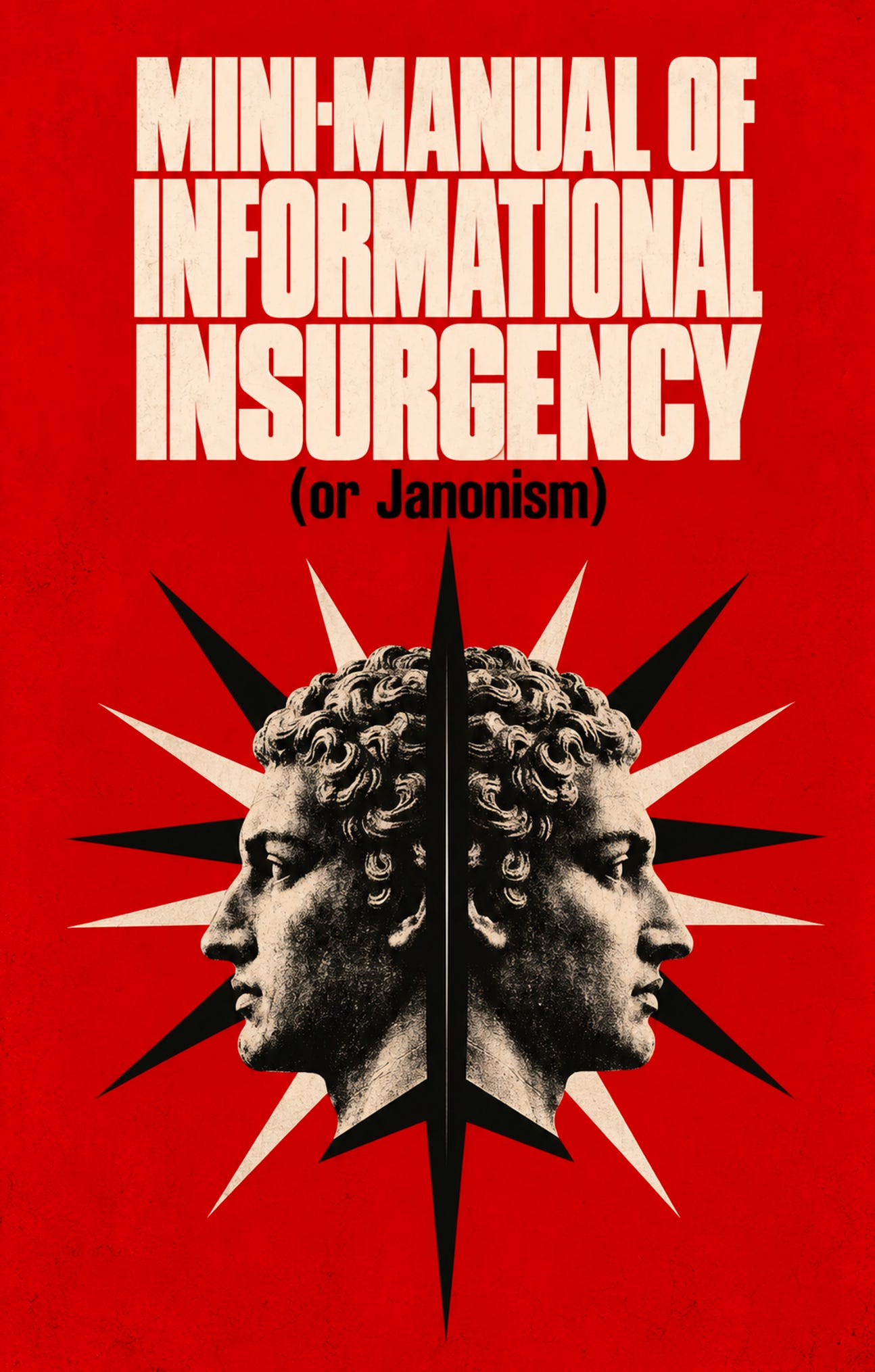
After the election, a text began circulating online, the “Mini-Manual of Informational Insurgency (or Janonism),” a 19-page PDF by two pseudonymous authors, released in Portuguese along with translations into nine other languages (including Swedish, Arabic, and Japanese). It charts how the “informational battle” should be won, using a set of algorithmically attuned approaches. The manual has received some attention on English-speaking social media as well, with one video explainer on Instagram getting more than 10,000 likes.
So what can we learn about today’s political dynamics by reading this manual carefully? As a diagnosis of contemporary “platform politics” and a tactical blueprint for digital electoral mobilization, the manual is surprisingly, perhaps sadly, insightful; considered as a theory of how democratic politics ought to operate, it risks converging with the very forces it opposes—even if Silicon Valley’s reconfiguration of liberal democracy is still clearly the larger issue.
The manual, it should be said, is in no way an official publication of the Lula campaign, and nothing suggests that Lula’s team or Janones endorsed it. We should therefore treat it with caution as an account of how any particular campaign was run, though some of the practices the manual describes are documented in media coverage of the election, albeit without the authors’ social theory framing. What interests me more is the manual as symptomatic of certain ailments in platform politics. (Quotations below are from the English translation released by the authors.)
To Mirror and Amplify
Through twelve principles, the authors want to teach activists and movements how to win at politics. One set of tactics is about amplification: liking and reposting your own side’s posts (no. 1), keeping an eye on the other side’s content (no. 3), and ensuring consistency in messaging through a centralized line, or “recognizable political vector” (no. 4), with posts spread by thousands of accounts in a dispersed manner, together “tak[ing] the form of a wave.” They advocate using AI tools to “flood the networks with political material” (no. 7).
Another tactic is the idea that one should “never engage with the opposing side” (no. 2) on social media, since doing so will only serve to draw attention to its message. One could call it the Sauron’s-eye theory of algorithmic attention: engagement pulls in the algorithm’s gaze and amplifies whatever it centers on. “Follow the opposition’s moves,” yes, but “without turning every provocation into a public dispute.”
A second cluster revolves around the struggle over meaning. The first tactic is mirroring (no. 8), or inverting the opponent’s slogans, memes, and hashtags rather than answering them directly. “A post saying ‘We’re going to retire Lula,’” the authors write, “is not answered with comments defending the president, but with another post saying ‘We’re going to retire the Bolsonaros.’” The point is to meet like with like, without direct engagement. The second is “appropriating and destabilizing signs” (no. 9), for instance by reclaiming the Brazilian soccer team’s jersey and the national flag from the far right. But they say little about the risks of appropriating national symbols: how does one adopt the trappings of nationalism without turning nationalist? The third is “memetic hyperstition” (no. 10), a concept drawing on Nick Land, now an ideologue of the neoreactionary right. Here, a confident campaign assumes victory is inevitable in order to usher it into existence, speaking in what the authors call the “prophetic past tense.” This all sounds very good when it works out; but what of all those elections that supporters were certain of winning and then didn’t?
A third set of tactics concerns breaking out of the digital bubble, in two senses. First, escaping algorithmically hardened clusters of users in which campaigns might otherwise find themselves trapped, by creating “bubble-breaking content” (no. 6) capable of reaching beyond one’s algorithmically naturalized audience. Second, connecting the digital to the physical world (no. 12): it’s easy to think that everything is now digital, but lots of political engagement still occurs at street level, in physical reality (even if the boundary between the digital and the physical is now extremely porous). Principle no. 5, which invokes Deleuze and Guattari’s theory of “the face” (glossed by the authors as “the Face is a machine”), makes a simple observation: getting ordinary people, or “low-profile users,” to carry political messages is an effective way of making political positions seem salient to people.
Finally, “anything goes” (no. 11) is a meta-tactical principle governing all the rest. The only ultimately meaningful guide to what “issues and methods” a movement should take up, the authors suggest, is whatever “favor[s] the cause” and has “engagement potential.” They flatten publicizing pro-worker government policies, “thirst traps,” and “shitposting” into equally valid engagement drivers. This is reductive; at best, it’s a radically agnostic approach to communications. The manual’s silence on whether this extends to bending or breaking the truth is significant, too. Janones, for his part, has “admitted to lobbing half-truths in his messages,” according to the Times.
Contagion, Not Consciousness
The manual’s organizing metaphor is that of warfare: digital activists are likened to “‘soldiers’” who fight in an “informational battle”; political campaigns should organize digital “patrols.” Its dominant image is the network, whose goal is to secure “hegemony” in the realm of perceptions: successful political campaigns are likened to a kind of “DDoS attack,” where the point is not pedagogical but proliferative. “The very term consciousness-raising is no longer of any use,” they write; instead, “WHAT REALLY MATTERS IS CONTAGION.” This is Leninist democratic centralism without any sort of activist or civic education. And it feels dystopian: retweet, don’t think.
Still, many of the manual’s tactics are just common-sense, field-tested tricks of the trade in the age of social media. You don’t need the poststructuralist, accelerationist–Leninist theoretical baggage to accept that aiming for consistency in messaging by coordinating with campaign HQ is a good idea; you don’t need to be Deleuzean to appreciate that ordinary social media users could be a valuable asset, or that you should keep an eye on what your opponents are up to and respond in kind.
Where things get dicier is the manual’s outright dismissal of deliberation: “The dream of a digital public sphere for deliberation through rational arguments is over.” In place of the Habermasian “unforced force of the better argument,” the manual posits “informational brute force,” aimed at capturing maximum attention by dominating the algorithm—a Bannon-style “flood the zone” approach, or “flooding the infosphere,” as it repeatedly puts it. This is a vision of the public sphere not as a site of rational debate—citizens are not meant to exercise independent critical thought—but as a theater of war where centralized military authority and distributed discipline reign supreme, and where the point is to win the struggle for “hegemony.” It’s an adaptation, they suggest, to the harsh realities of platform politics. The resulting worldview is decidedly bleak. People are viewed as cogs, or rather, “nodes”: “The participant in Janonist action is not the Enlightenment’s ‘autonomous subject,’” the manual holds, “but an amplification node in a coordinated communications network seeking hegemony on social media.”
There’s also a very practical problem with the sort of attention hacking they advise: what’s to stop anyone from adopting their ideas, including the far right? Mirroring cuts both ways. Politics has become an information-tactical arms race, and as everyone knows, there are only temporary winners in arms races; each escalatory cycle, meanwhile, further degrades the information environment. The manual dismisses deliberation as a “dream,” but there’s nothing more dream-like, and even naïve, than hard-nosed realism.
To be fair, the authors do not normatively embrace the platformized politics we find ourselves in as if it were an ideal position; theirs is an immanent tactics aimed at maximizing gains and keeping the far right from winning in a debased reality. Their opponent on the far right “relies heavily on favorable treatment by platforms,” they claim, “and on buying views to boost ‘spontaneous engagement.’” What’s a progressive movement supposed to do? And again, some of the ideas here are just good organizing, from coordinating to mirroring and trying to figure out the rules of the algorithm, even as these approach folk theories, impossible to verify or falsify, that may be misleading in their own way. I wonder, too, whether their axiom that “engagement is engagement” doesn’t gloss over the meaning of meaning, so to speak: even if the algorithm is indifferent to the meaning of engagement, the content does matter to readers. Not all engagement, whether critical or effusive, is created equal, or has the same audience effect. To believe otherwise is to succumb to a kind of communicative nihilism.
Yet it’s hard to rid oneself of the feeling that adopting the manual’s communicative ideology wholesale would make monsters of progressives. There is a case to be made for using the master’s tools, of course—but at what price? Changing the terms of political struggle may be a luxury movements facing down the far right can’t afford in the near term; still, progressives will have to consider whether they can meaningfully secure “hegemony” without reforming both the content and the form of politics. An “anything goes” approach to winning elections, where the only limit on means is whether they serve the cause, looks less like a defense against the far right than a convergence with it. The digital space is a terrain to be won, certainly, but not at any price.