


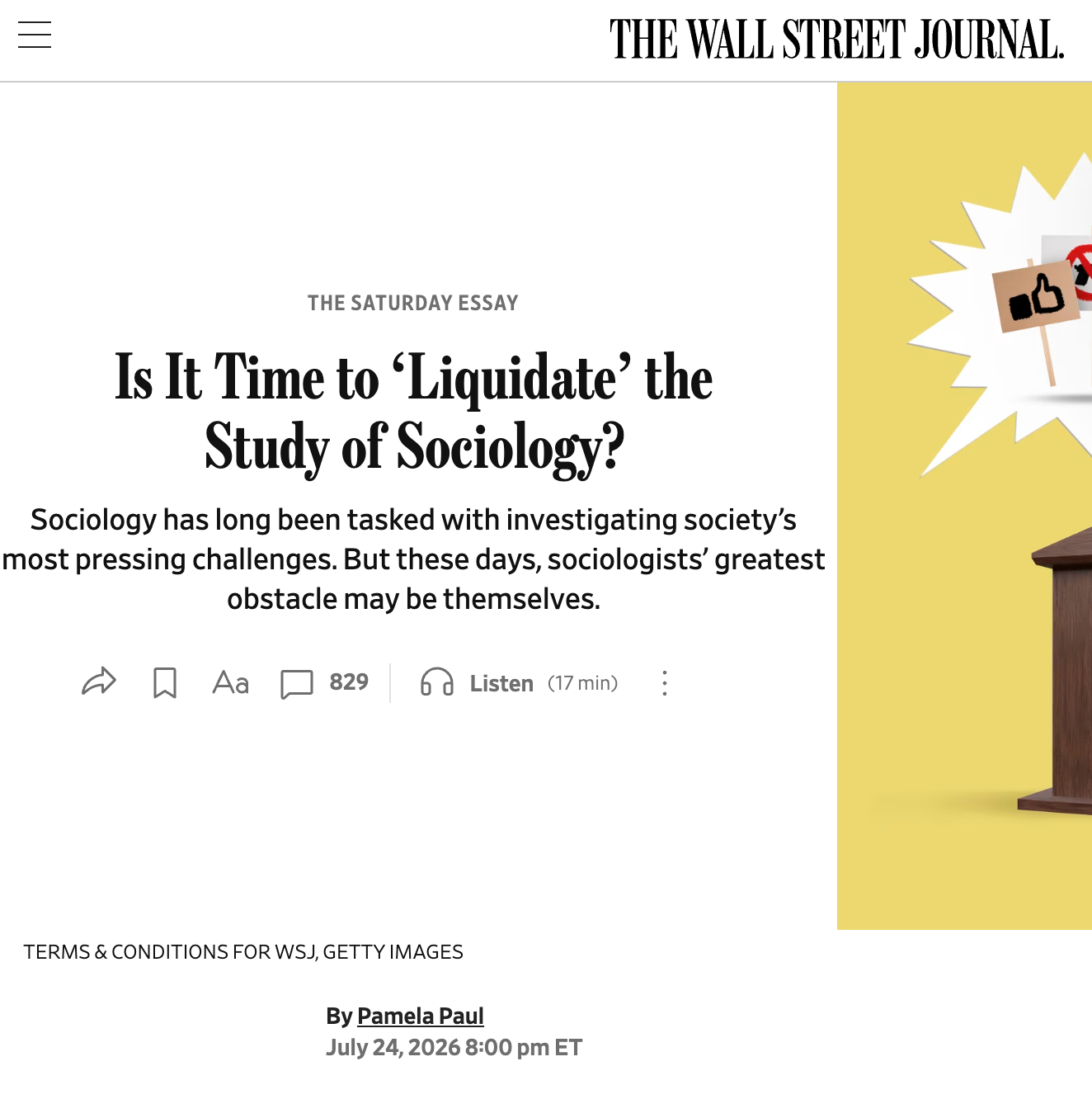
A recent Wall Street Journal piece asks whether it is time to liquidate sociology—not a question one is used to hearing about academic disciplines, it must be said, in liberal-democratic societies. A disgruntled ex-professor of Notre Dame, Christian Smith, is quoted in the piece as asking: “Over time, I’ve thought to myself, ‘What if we just liquidate the discipline?’” (Smith wrote a public break-up letter with academe, where his chief complaint seems to have been that his employer was insufficiently Catholic.) “Liquidation” might be the language of insolvency and bankruptcy, just barely defensible. But it is also a term associated with harsh authoritarianism, an instrument for imposing social and ideological control. It is surely ironic that the right, which rails against the dangers of so-called cancel culture, wants to delete an entire field because it doesn’t conform to the right’s own viewpoints. The plea for, or question of, “liquidating” sociology is inherently authoritarian. But we should also ask whether such faux-innocent probing about liquidating sociology might not in turn morph into a plea for liquidating sociologists—whether by funding cuts, hiring freezes, or lay-offs.
We should avoid falling into the trap of adjudicating the essay’s largely spurious allegations, which read like caricatures of critical sociological scholarship (where studies of policing or parole devolve, according to one professor interviewed, into claims that “policing is bad, parole is bad”—again, pure caricature). Instead, we should ask: What is the political impetus behind articles such as this, and what are the likely effects of the wider discursive and organizational formation driving these attacks? Pamela Paul, the WSJ essay’s author, cites a number of sociologists, enlisting them to her cause. Jukka Savolainen and Kevin McCaffree are two figures associated with Theory & Society, the once venerable sociological theory journal founded by Alvin Gouldner in the 1970s and later, in more recent years, the subject of something like an editorial coup. The publisher, Springer, imposed a new editor, the same Kevin McCaffree, along with another academic, Jonathan Turner, resulting in the editorial board’s mass resignation in protest; the new Springer-favored editors have since converted this once-esteemed journal into an outlet for anti-woke, so-called heterodox writings.
The WSJ piece comes on the heels of the Vanderbilt Report, a full-throated attack on the humanities and parts of the social sciences. One of the members on the commission’s panel, Ashley Rubin, is also a member of the reconstituted Theory & Society editorial board. Rubin recently participated in something called the Heterodox Social Science conference, organized by Eric Kaufmann, a professor at the University of Buckingham who penned the book Whiteshift (2018), which offered a sociological fig-leaf for “cultural anxieties” over immigration. Kaufmann has been on the Heterodox Academy’s podcast. The Heterodox Academy’s Speaker’s Bureau lists Rubin, as well as Musa al-Gharbi, another of the WSJ interviewees. Savolainen describes himself on X as a bearer of “Heterodox opinions,” and also participated in the Buckingham conference this July; he notes, in a post about the WSJ essay, that “many members of the @HdxAcademy [Heterodox Academy] sociology community were interviewed.” Meanwhile, the ex-Notre Dame professor Christian Smith’s book, The Sacred Project of American Sociology, has been written about glowingly by al-Gharbi on the Heterodox Academy website. The more one considers these organizational affiliations and mutual affinities, the more the WSJ piece reads like the opinions of one narrow subset of academics about a global, sprawling, diverse, multi-methods discipline.
What, or who, is behind this thirst for heterodoxy? One of the Heterodox Academy’s (HxA) largest funders is the Templeton philanthropies—the John Templeton Foundation and its sister entity the Templeton Religion Trust—which together have committed around $6 million in disclosed grants to HxA, including a $2.8 million grant (“Promoting Open Inquiry, Viewpoint Diversity, and Constructive Disagreement on American College Campuses and in the Disciplines,” 2019–2022). The group also received “substantial support” from Paul Singer, a “hedge-fund billionaire active in Republican politics,” support that, according to the Chronicle of Higher Education, “allowed it to work with a Washington-area branding and public-relations firm.”
At the recent Buckingham Heterodox Conference, speakers also included Richard Hanania, a right-wing polemicist, and Chris Rufo, a prominent MAGA-aligned activist, architect of the crusade against “critical race theory,” and senior fellow at the Manhattan Institute—“The Think Tank Fueling Trump’s War on Higher Ed,” as The Chronicle of Higher Education recently wrote. Rufo was invited to Mar-a-Lago in late 2024 to present the incoming Trump administration’s team with, in the Wall Street Journal’s own words, “a plan to geld American universities by withholding money.”
Heterodoxy is not what it once was. Trump 2.0 has seen the right-wing appropriation of the term’s meaning, taken now to cover anyone who charges against liberal norms and progressive values. But heterodoxy is not intrinsically desirable; some orthodoxies are worth defending. If society has progressed to the point where transgender people can live safely and freely, or ethnoracial minorities can exist without discrimination, or women can vote, work, and make their own reproductive choices, then the orthodoxies that enshrine those rights should be preserved against firebrand “heterodox” figures. Unsurprisingly, the WSJ’s Pamela Paul was criticized for her transgender coverage while a New York Times Opinion section writer, described by the Pulitzer Prize-winning critic Andrea Long Chu as a “zealot attired as a skeptic, one who has gladly paved the way for the anti-trans right.” The story of the far right this past decade has been the appropriation of the insubordinate energy and imagery of the 1960s by the right, such that they can now pretend to be the “real” or “new” rebels. And in some sense, they are: They are rebelling against liberal-democratic, progressive norms and values. But rebellion is not inherently good. (In the Biblical tradition, after all, Satan was a rebel against God.)
Behind the rhetoric of scientificity, liquidation talk is an attempt to reshape the academy in the image and likeness of a particular form of radical conservatism. The rise of right-wing heterodoxy in the social sciences is an insurrection against anything that offends conservative sensibilities. It can rightly be described as a reactionary mode of politics, a reaction to a discipline that still, against the odds, has the capacity to infuriate wielders of power. The mere suggestion that the institutions of the state or market actors ought to be subjected to systematic critique is an offense to this point of view. The notion that a wide range of social groups ought to enjoy a diverse bundle of rights, freedoms, and protections is an affront. (The critics assembled by the WSJ decry a “relentless focus on race, gender and class.”) And the idea that the social sciences—not just sociology, which is hardly alone in this matter, given its close links to anthropology but also in some instances political science, history, and the wider humanities—should study how power is exercised, sometimes to the detriment of vulnerable groups, is, seemingly, intolerable. Liquidationist politics is, in other words, an attempt to stamp the academy with the values of the right. In this regard, “heterodoxy” does the bidding of Trumpism perfectly. Whatever their self-understanding might be, the bearers of this heterodoxy function as Trumpism’s academic vanguard, softening the social sciences before the political circumscriptions and funding cuts arrive on the scene.
We have already seen the effects of what being anti-woke and anti-DEI in the age of Trump 2.0 might mean for academic freedom. At Texas A&M, the women’s and gender studies program has been eliminated. In Florida, a “sanitized” sociology textbook has been created that “now makes only cursory mentions of important sociological concepts regarding race, gender, sexuality and other topics that have drawn Republican ire,” according to Inside Higher Ed. This “state-approved textbook”—a phrase redolent with authoritarianism—has rightly been criticized by faculty, who question how one might begin to “imagine thinking about how people live their everyday lives and assume that social stratification, class, race, gender don’t matter,” as William Marsiglio, a professor at the University of Florida, has said. Another faculty member at Florida International University, Zachary Levenson, called it a “coordinated assault on civil rights in the state, in the country, including censoring the nation’s history.”
Whether one intends it or not, being “heterodox” today means, paradoxically, being on the side of a powerful reactionary force.
This is a great piece. Thanks for writing it!
This all reminds me of a campaign for an «academic bill of rights», led by David Horowitz, that the AAUP fought back in the early 2000s: https://www.aaup.org/reports-publications/aaup-policies-reports/topical-reports/academic-bill-rights