


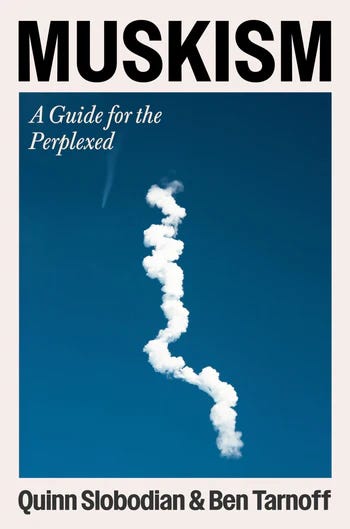
Quinn Slobodian and Ben Tarnoff, Muskism: A Guide for the Perplexed (HarperCollins, 2026).
Elon Musk is one of the most powerful people alive. SpaceX’s IPO in June made him history’s first trillionaire, and his companies increasingly control essential infrastructure both on and off Earth, from launch vehicles to satellites, EV production, AI compute, and a still-influential social media platform. His $44 billion purchase of Twitter helped Trump win the 2024 presidential election—Bloomberg found Musk to be the platform’s single most important spreader of anti-immigrant conspiracy theories—and his $288 million in Republican campaign donations allowed him to aim, at least for a time, the DOGE wrecking ball at the U.S. government’s administrative, assistive, and redistributive wing. Millions are projected to die as a result of USAID cuts, according to a Lancet study. Musk’s power, both corporate and political, is growing, and he is unafraid to use it to further his far-right goals.
Yet books on Musk have been dominated by a tendency to idolize their subject, from Ashlee Vance’s nerd-hagiographical 2015 biography, to Walter Isaacson’s bestselling mythologization of Musk’s alleged genius (2023). A critical-structural analysis is long overdue. Quinn Slobodian, one of the most incisive historians of neoliberalism—from Globalists (2018) to Crack-Up Capitalism (2023) and Hayek’s Bastards (2025)—has shown how the neoliberal project has entailed not so much freeing markets from the state as re-engineering the state to assist and empower capital, a project that has been deeply entangled with racialized notions of superiority. His coauthor, Ben Tarnoff, is the author of the left-technology tract Internet for the People (2022). The pairing promises to deliver a critique of Musk and, more controversially, “Muskism,” an -ism in his name denoting a political-economic “toolkit.”
Of course, the book’s subtitle, “A Guide for the Perplexed,” invites the counter-question: Who, exactly, is still perplexed by Elon Musk? The man leaves little room for mystery. He is an inveterate social media poster; he has made no secret of his increasingly extreme politics; and he is building an empire seemingly modeled on libertarian science-fiction paperbacks from the 1960s. There is nothing particularly secretive about the man. Back in 2019, a colleague and I described Musk’s business model as charismatic accumulation: charisma in Weber’s sense—the mobilization of extraordinary enthusiasm around Musk as a person—serving as the engine of his corporate empire’s debt-fueled, narratively enhanced growth. With self-driving cars perpetually right around the corner, and humanity allegedly set to become “multiplanetary,” Musk’s real-life Iron Man/Tony Stark persona has been pumped up by a supportive press.
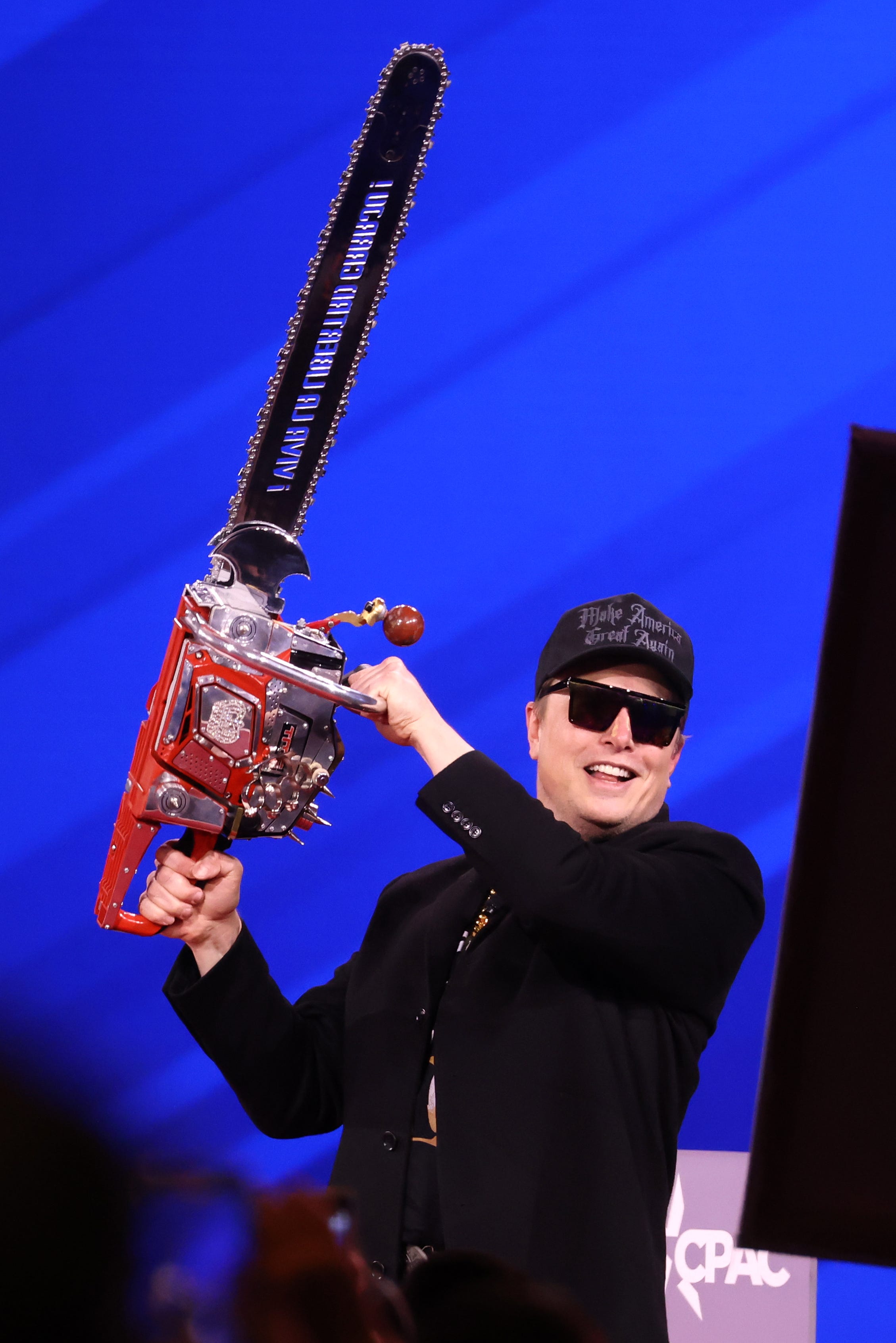
None of it was ever particularly mysterious. Instead, Musk is exactly what he appears to be: a far-right-supporting oligarch born and raised in apartheid South Africa who arrived in Silicon Valley just in time to ride a wave of cheap credit, easy venture capital, and generous government contracts, and now works tirelessly for a global right-wing oligarchic capitalism because it benefits him and his booming enterprises. After the Nazi-style salutes of January 2025 and thousands of posts revealing a racist, transphobic, far-right worldview, the real puzzle is why so many keep backing him—from Tesla-driving, Starlink-surfing consumers to governments and corporations that continue doing business with him. Musk has agency, but we also need to understand the social order that has allowed him to rise and garnered him so many fans in spite of his patently noxious beliefs and actions.
Slobodian and Tarnoff are not writing biography. Instead, they present Musk as the bearer of a new political-economic rationality, “Muskism,” modeled on Fordism (after Henry Ford) as anatomized by Antonio Gramsci, with its automation and assembly lines, relatively high wages, and revolution-averting compromises between capital and labor.
What, then, is Muskism? On the production side, a “lean Fordism”: hyperefficient factories—think Tesla’s Gigafactories and SpaceX’s Starfactory—with radically integrated supply chains, run with the cultural freneticism of a Silicon Valley startup. On the consumption side, what the authors call techno-sovereignty: products promising individuals and, increasingly, states more autonomy. The promise, of course, is largely illusory: It is an entry “into Musk’s walled garden, to which he holds the master key,” as the authors put it. “Trying to unplug from Musk, you realize he owns the socket.”
Fordism was a response to a fundamental problem in industrial capitalism: It offered a social contract intended to engender social stability, stave off working-class radicalization, and deepen capitalism’s legitimacy. What Muskism is meant to solve remains unclear; if anything, it promises greater polarization, destabilization, and conflict. The authors sense this, conceding that Muskism is less a “governing philosophy” than “a toolkit available to those who govern.” Something essentially new is afoot, they recognize—though not, contra Varoufakis and others, “technofeudalism”—but what it constitutes, as a general model beyond the empirical case of Musk, is never quite made clear.
Slobodian and Tarnoff are right to highlight one of Musk’s signature intuitions: that there are great fortunes to be made in the fusion of state and capital—“sovereignty as a service,” in the authors’ phrase, or what I have elsewhere called oligarchic infrastructure: private control over state-critical infrastructure, often funded and supported by the government itself, then turned into political leverage by a corporate titan like Musk. The Washington Post enumerates a whopping $38 billion in contracts, loans, subsidies, and tax credits to Musk’s companies, essential to his rise. With SpaceX on the verge of bankruptcy in 2008, for instance, a crucial $1.6 billion NASA contract saved the company. The hypocrisy peaked in April 2025, when SpaceX won a $5.9 billion Space Force contract while Musk himself led DOGE’s crusade against parts of the U.S. federal government. Today, the dependency has largely been turned on its head: Musk, the authors drily note, doesn’t need to “run a government to shape geopolitics.”
The chapter on Musk’s South African formation is particularly instructive. Apartheid South Africa was a white-supremacist terror state deploying advanced techniques of control and domination. The authors describe apartheid as a “data-driven project—a reactionary technocracy”: South Africa was a “biometric state,” in the words of historian Keith Breckenridge, where IBM mainframes stored racial classifications used to police the population—big data avant la lettre. What the authors call the country’s “fortress futurism”—the belief that technology is a route to “self-reliance in a hostile world”—made apartheid South Africa not an aberration or anachronism but a “precursor to our own time.”
The book’s second half shows how Musk’s corporatist sovereignty fantasy has gone cyborg, with humans increasingly meant to be fused with machines via X, Neuralink, and AI, but within a specifically “cyborg conservatism,” as Slobodian and Tarnoff aptly describe it: Humans and machines may melt together, but the population is to remain strictly “segmented by gender, race, and class.” The COVID-19 pandemic marked something of a tipping point in Musk’s evolution, as the fear of contagion was displaced from COVID-19 onto the “woke mind virus,” which Musk set out to purge—first from his newly acquired Twitter, then from AI itself via Grok (which promptly crowned itself “MechaHitler”).
In the chapter on DOGE, the authors analyze the role of an accountancy method, “zero-based budgeting,” where every organizational unit is meant to rejustify its budgetary items each year. ZBB owes its origins to Texas Instruments in the late 1960s and was long dismissed as unworkable; by the mid-2020s, proponents claimed, it had become practicable thanks to AI. Unsurprisingly, “zero-based budgeting rarely succeeds in cutting costs,” the authors write; “its real effect, in Musk’s hands, was the concentration of power.” The hunt for “waste, fraud, and abuse,” they observe, “blurred seamlessly into the hunt for illegitimate people: irregularities to be deleted”—like corrupted or superfluous data. Here the authors draw on Nick Bostrom’s idea of “shadow people” and Musk’s stress on “NPCs,” or non-player characters, an idea from computer games: the ontologically incomplete person who need not be cared for, but can safely be removed, deported, or “deleted.” Empathy is, in Musk’s own words, “a bug in Western civilization” to be patched.
While this book is a welcome move beyond pure biography, it likely will not be the final word. In their framing, Slobodian and Tarnoff write: “[W]e thought the more useful question is not who is Musk? but what is Musk a symptom of?” But a symptomatic reading of the world’s richest person gets the causality backwards. If anyone on this planet wields real agency, it must be Musk. They also overstate Musk’s ideological fluidity, insisting he is no “systematic thinker” beholden to any “fixed ideology.” He is certainly no political theorist or social philosopher. But the past decade in Musk’s life, as Muskism itself shows, has hardly been haphazard; instead, Musk has been on a relentless rightward march, now armed with a $44 billion communication platform.
Early in the book, the authors issue a warning: “At some point, society will stabilize on a new basis. Muskism could provide the foundation.” Fordism was foundational to the Western capitalist social order for at least half a century. The task now is ensuring that Muskism doesn’t play the same role this century.